Technology Company Decreased Lead Time for At-Risk Accounts By 10% With Kure
Project Summary
The problem: A technology organization was experiencing delays in identifying and responding to at-risk accounts, creating challenges for customer retention, operational efficiency, and revenue protection.
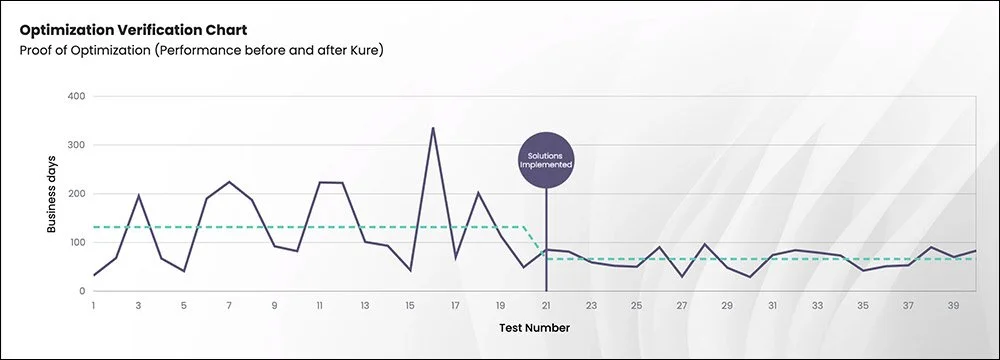
By using Kure to streamline workflows, improve visibility, and support faster decision-making, the organization reduced lead time from 80 days to 72 days, a 10% improvement, while saving 91% of at-risk renewal ARR and reducing administrative workload by 87%.
Introduction
A leading technology organization providing digital workplace solutions recognized the need to improve how at-risk customer accounts were identified, managed, and resolved. In a fast-moving customer environment, delays in responding to risk signals can impact retention, customer satisfaction, and long-term revenue growth.
To improve the process, the organization used Kure to centralize improvement efforts, simplify collaboration, and provide greater visibility into operational bottlenecks. Kure’s AI-assisted process improvement platform enabled the team to organize workflows, track improvement opportunities, and quickly identify areas causing delays.
Guided by Ethical Efficiency™, the project focused not only on achieving faster results, but also on creating a more sustainable and less burdensome process for employees responsible for managing customer risk.
The Problem
The organization struggled with a complex and time-consuming process for managing at-risk accounts. Teams relied on multiple disconnected systems, which made it difficult to quickly identify issues, coordinate responses, and maintain visibility across the customer lifecycle.
As delays increased, customer churn risk grew and renewal efforts became less effective. Customer Success Managers spent a significant amount of time navigating administrative tasks and manually managing information instead of focusing on proactive customer engagement.
Leadership recognized that improving the process was critical to protecting revenue, strengthening customer relationships, and improving operational performance.
The Root Causes
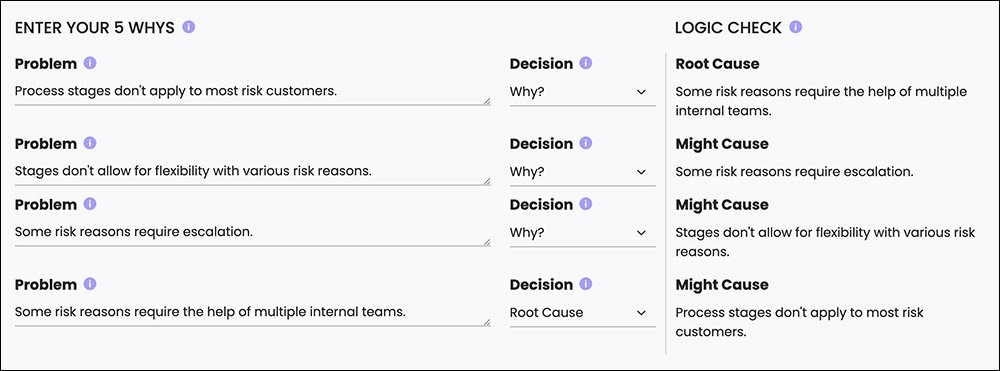
Using Kure to organize process analysis and improvement activities, the team identified several root causes contributing to the delays.
At-risk accounts often required coordination across multiple departments, slowing response times and creating inconsistencies in execution. In addition, teams lacked a standardized definition of when an account should no longer be considered at risk, resulting in confusion and inconsistent follow-through.
The organization also managed account risk and renewal risk separately across different systems. This created duplicate work, fragmented visibility, and unnecessary administrative effort.
Without centralized visibility into the process, teams struggled to act quickly and consistently when customer intervention was needed most.
The Solutions
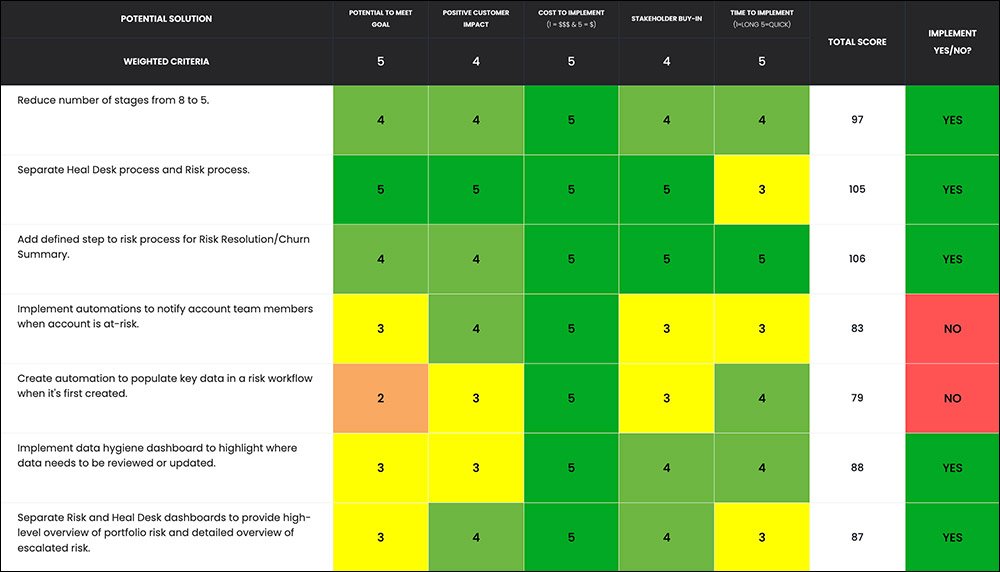
Using Kure to support process redesign and execution, the team implemented several targeted improvements.
The overall workflow was simplified from eight stages to five, eliminating unnecessary complexity and accelerating decision-making. Risk management and Help Desk activities were separated into clearer workflows so teams could focus more effectively on their responsibilities.
The team introduced a structured Risk Resolution and Churn Summary step to improve consistency and establish clearer process completion criteria. Dashboards were developed to improve data visibility, highlight data quality gaps, and provide both portfolio-level insights and detailed escalation tracking.
Kure also helped centralize documentation, improvement tracking, and collaboration efforts, making it easier for teams to stay aligned throughout implementation. AI and automation capabilities were introduced to reduce manual effort and accelerate response times.
The Results
The organization achieved measurable operational and business improvements.
Lead time for managing at-risk accounts decreased from 80 days to 72 days, resulting in a 10% improvement. The team also preserved 91% of at-risk renewal ARR during the first quarter following implementation.
Administrative workload was reduced by 87%, allowing Customer Success Managers to dedicate more time to customer engagement and proactive support.
By simplifying workflows, improving process visibility, and reducing manual work, the organization created a more agile and sustainable system for managing customer risk.
Conclusion
This project highlights how Kure can help organizations simplify complex operational processes and accelerate meaningful improvement efforts.
By centralizing process improvement activities, improving visibility, and supporting faster analysis and execution, Kure enabled the team to identify root causes, implement targeted solutions, and achieve measurable results more efficiently.
Guided by Ethical Efficiency™, the organization improved both operational performance and employee experience by reducing unnecessary complexity and administrative burden.
With a stronger process foundation and improved visibility now in place, the organization is better positioned to strengthen customer relationships, improve retention efforts, and support long-term operational success.
*We value our clients’ confidentiality. While we’ve changed their names, the results are real.