Laboratory Reduced Bar Code Scan Errors By 64% With Kure
Project Summary
The problem: Barcode scan errors were slowing laboratory operations and creating delays in sample processing, rework, and customer service.
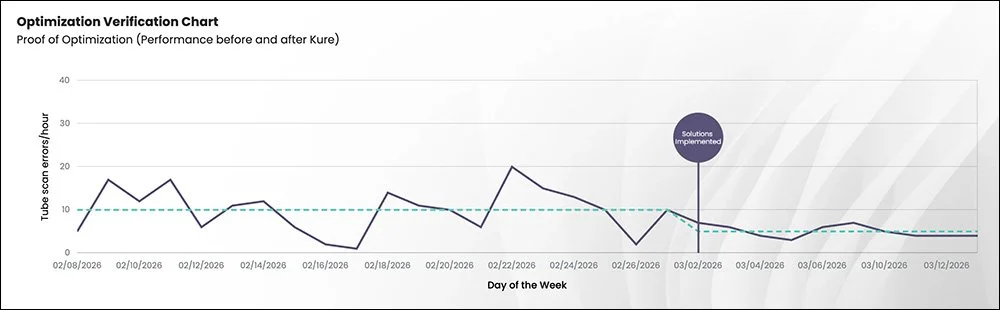
After applying Kure’s process improvement platform and methodologies, the laboratory reduced barcode scan errors from 11 errors per hour to just 4 errors per hour, a 64% improvement in scanning accuracy and process performance.
Introduction
In laboratory testing environments, accuracy and speed are essential. Every sample must be tracked correctly, and even small process issues can create delays, increase workload, and impact customer confidence. Because barcode scanning is a critical part of maintaining sample traceability, frequent scan errors were creating unnecessary disruptions throughout the operation.
To address this challenge, the laboratory leveraged Kure’s AI-powered process improvement platform to better understand the causes of barcode scan failures and implement sustainable solutions. Using Kure’s structured project management, process improvement tools, and collaborative workflows, the team was able to identify improvement opportunities, organize corrective actions, and track progress from start to finish. Guided by the principles of Ethical Efficiency™, the project focused on improving performance while supporting employees, reducing frustration, and ensuring customers received accurate and timely service.
The Problem
The laboratory was experiencing a high number of barcode scan errors during routine operations. These errors slowed sample processing, increased cycle and lead times, and created additional work for employees who had to repeatedly rescan or manually verify information.
As scan failures accumulated, the impact extended beyond internal inefficiencies. Delayed processing affected order fulfillment and customer experience, while repeated errors increased the risk of misinformation and rework. Staff members became frustrated by the frequent interruptions, and valuable time was being spent correcting problems instead of completing productive work.
For an organization that depends on accuracy, speed, and traceability, improving barcode scanning performance was essential. Reducing errors would not only improve operational efficiency but also strengthen customer trust and support long-term growth.
The Root Causes
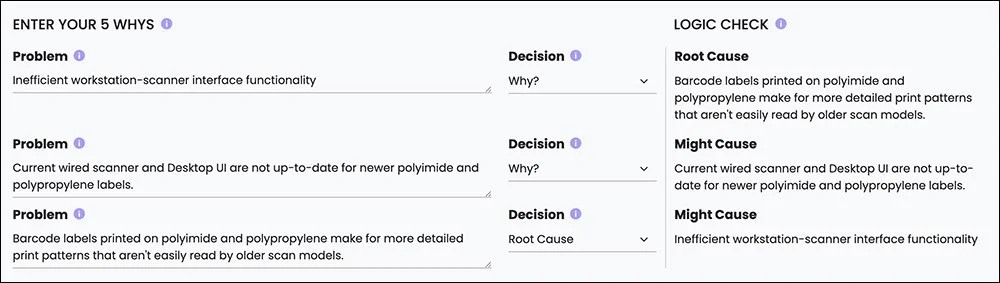
Using Kure’s process improvement tools and structured analysis capabilities, the team identified several factors contributing to the barcode scanning issues.
One major challenge was aging scanner technology. Older scanners struggled to consistently read newer barcode formats and dense print patterns commonly found on laboratory labels.
The barcode labels themselves also contributed to the problem. Differences in label materials and print quality made some barcodes more difficult to read than others.
Environmental conditions created additional obstacles. Frost and condensation formed quickly on cryovials, partially covering barcodes and requiring operators to repeatedly wipe containers before scanning.
The physical work environment also played a role. Coiled scanner cords limited operator movement, making it more difficult to position scanners correctly. In addition, some labels were placed in orientations that made scanning less effective, particularly when the scanner crossed the barcode pattern at unfavorable angles.
Together, these factors created a process that was prone to interruptions, delays, and unnecessary rework.
The Solutions
The team used Kure to organize improvement activities, document findings, assign actions, and collaborate on solutions across departments.
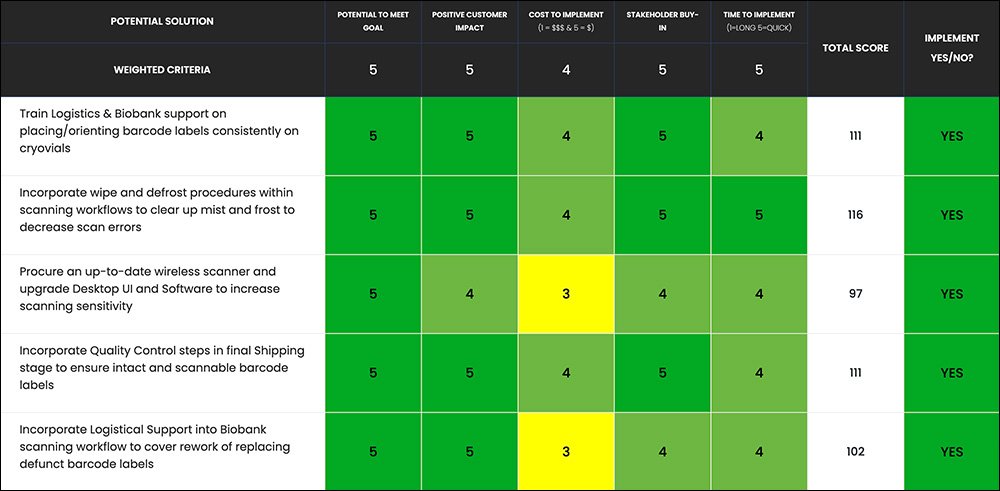
Training was provided to logistics and biobank personnel on proper barcode label placement and orientation. Clear standards helped ensure labels were positioned for optimal scanner performance.
New workflow steps were introduced to address frost and condensation issues. Staff incorporated wiping and defrosting procedures into the scanning process, and incubation times were adjusted to allow moisture to dissipate naturally before scanning.
The laboratory upgraded to modern wireless scanners and improved the desktop software interface. These upgrades increased scanning sensitivity while giving operators greater flexibility and ease of movement.
To prevent issues from reaching customers, additional quality checks were added before shipment. Barcode labels were verified for readability, and support processes were established to quickly replace damaged or unreadable labels.
The team also standardized barcode label materials by transitioning fully to polypropylene and polyimide labels, creating greater consistency and durability across the operation.
The Results
The project delivered measurable and meaningful improvements.
Barcode scan errors were reduced from 11 errors per hour to just 4 errors per hour, representing a 64% reduction in errors.
With fewer scanning interruptions, operators worked more efficiently and spent less time troubleshooting barcode issues. Workflow speed improved, rework decreased, and overall process reliability increased.
The improvements also enhanced the customer experience. Faster processing times and more accurate sample tracking helped improve service quality while strengthening confidence in the laboratory’s operations.
Beyond the immediate performance gains, the organization improved inventory integrity, reduced operational frustration, and created a more dependable process capable of supporting future growth.
Conclusion
This project demonstrates how a focused process improvement effort can produce significant results in a highly demanding laboratory environment. By leveraging Kure’s integrated process improvement platform, the team was able to identify root causes, manage improvement activities, and implement practical solutions that delivered lasting impact.
Consistent with Ethical Efficiency™, the project balanced operational performance with the needs of both employees and customers. By reducing frustration, minimizing rework, and improving service reliability, the team created benefits across the entire value stream.
Kure’s combination of project management, collaboration tools, process improvement resources, and AI-powered analysis helped the team move from problem identification to measurable results quickly. With barcode scan errors reduced by 64% and processes operating more smoothly, the laboratory is well positioned to continue improving performance, supporting customers, and driving operational excellence in the future.
*We value our clients’ confidentiality. While we’ve changed their names, the results are real.