Technology Company Decreased New Hire Onboarding Time By 33% With Kure
Project Summary
The problem: A technology organization was experiencing a slow and inconsistent onboarding process that delayed new employee productivity, increased operational costs, and placed additional pressure on existing team members.
After using Kure to streamline and manage its improvement project, the organization reduced new hire onboarding time from 45 business days to 30 business days, a 33% improvement that accelerated employee readiness, reduced productivity losses, and created a more consistent onboarding experience.
Introduction
Hiring great employees is only the first step toward building a strong workforce. Organizations also need an onboarding process that helps new hires become productive as quickly as possible. When onboarding activities are delayed or poorly coordinated, projects slow down, experienced employees spend more time filling staffing gaps, and new hires struggle to contribute.
To address these challenges, the organization used Kure to organize its improvement initiative, collaborate across departments, and track progress from opportunity identification through implementation. Throughout the project, the team embraced the principles of Ethical Efficiency™, focusing on eliminating waste, improving the employee experience, and making better use of existing resources rather than increasing workloads.
The Problem
The organization's onboarding process depended on several departments working independently, with little coordination between Human Resources, IT, hiring managers, and other support teams. As a result, new employees frequently waited for equipment, system access, and required training before they could begin working independently.
On average, it took 45 business days for a new employee to become fully productive, significantly longer than the organization's goal of 30 business days.
These delays slowed project delivery, increased pressure on experienced employees who covered vacant positions, and contributed to higher training costs. The organization estimated the inefficient process was costing nearly $15,000 each month, or approximately $180,000 annually, in lost productivity and additional support effort.
The Root Causes
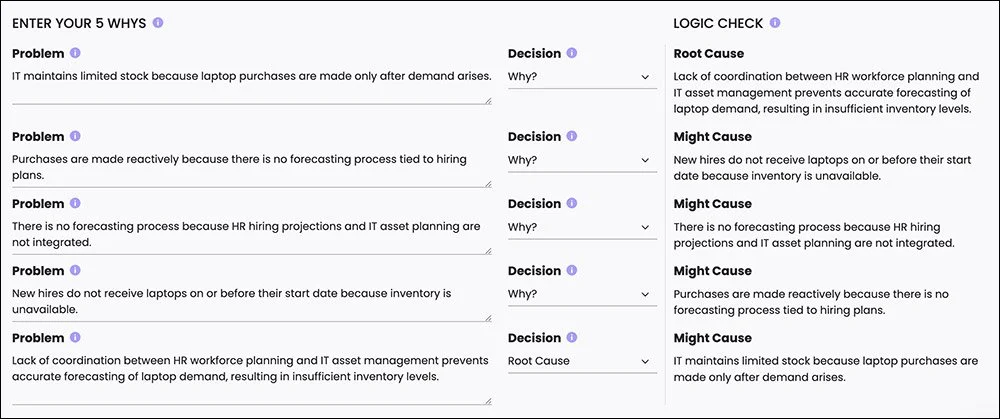
The improvement team used Kure to document findings and identify the primary causes of the delays.
There was no standardized onboarding process to ensure equipment, system access, and required training were completed before an employee's first day. Responsibilities were also unclear, leaving departments to manage their own activities without a single person coordinating the overall process.
The team also discovered weak communication between Human Resources workforce planning and IT asset management. Limited forecasting resulted in laptop shortages that delayed employee readiness and extended onboarding time.
The Solutions
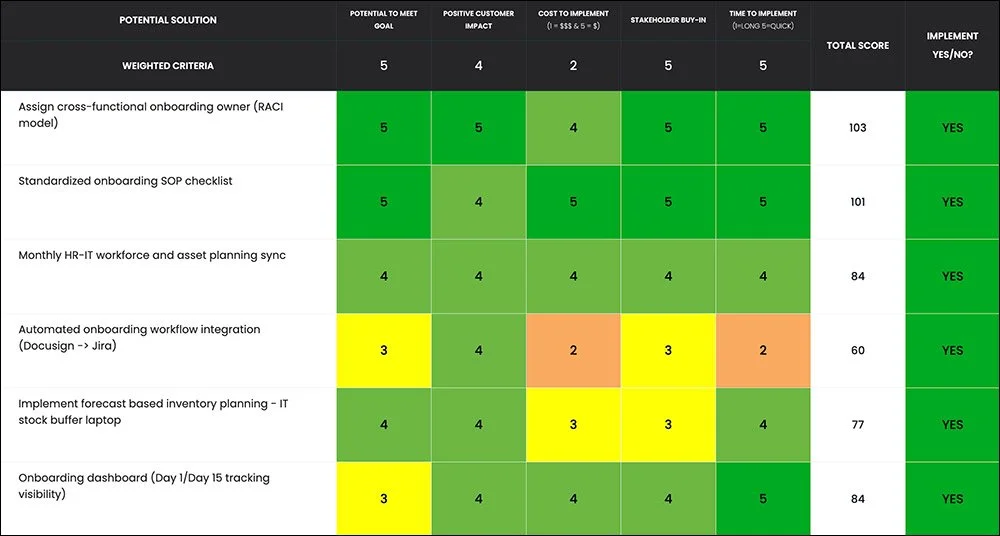
Using Kure to organize the project, assign actions, and monitor implementation, the team redesigned the onboarding process to improve coordination and accountability.
A cross-functional onboarding owner was assigned using a RACI model to clearly define responsibilities across departments. A standardized onboarding checklist ensured every employee followed the same consistent process and received the required equipment, access, and training before beginning work.
Monthly planning meetings between Human Resources and IT improved hiring forecasts and laptop inventory planning. Automated workflow integration between DocuSign and Jira reduced manual coordination while improving communication across teams.
The organization also introduced forecast-based inventory planning for IT equipment and implemented an onboarding dashboard that monitored employee progress on Day 1 and Day 15, giving managers real-time visibility into onboarding performance.
The Results
The improved onboarding process produced measurable benefits throughout the organization.
Average onboarding time decreased from 45 business days to 30 business days
33% reduction in onboarding lead time
Lower productivity losses and reduced training costs
New employees became productive much sooner
Existing employees spent less time covering vacant positions and providing extended coaching
A standardized onboarding process improved consistency across departments
By removing unnecessary delays and improving collaboration, the organization created a faster, more predictable onboarding experience that benefited employees, managers, and the business.

Conclusion
This project demonstrates how improving coordination and standardizing work can significantly accelerate employee onboarding. By using Kure to manage the improvement effort, the organization reduced onboarding time by 33%, helping new employees contribute more quickly while lowering operational costs and reducing unnecessary workload on existing staff.
The project also reflected the principles of Ethical Efficiency by eliminating waste, improving planning, and creating a process that better supports people rather than simply expecting them to do more. Kure provided a centralized platform to organize ideas, assign responsibilities, monitor progress, and capture measurable results, helping the team implement improvements faster while creating a repeatable process for future initiatives. With a streamlined onboarding system now in place, the technology organization is well positioned to support future growth, strengthen employee engagement, and sustain long-term operational excellence.
*We value our clients’ confidentiality. While we’ve changed their names, the results are real.